
 Tiếng Việt
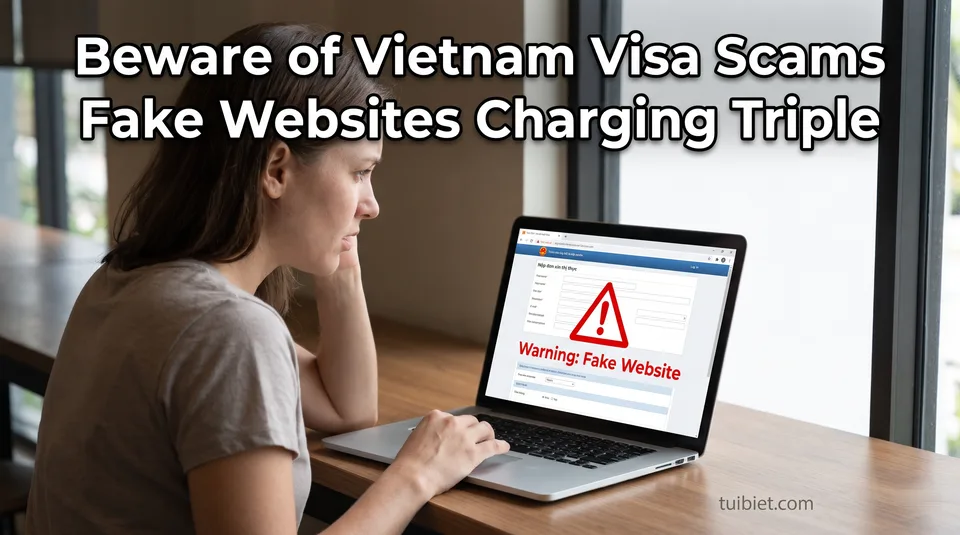
Type “Vietnam visa” into a search engine and the first results are often advertisements for websites dressed up to look official — government-style names, national colours, urgent countdown timers. Many of them are not the government at all. Vietnam visa scams and markup sites have become the most common way travellers overpay for their visa: the official e-Visa carries a fixed government fee, yet look-alike websites routinely charge two to three times as much — and the worst of them take your money and your passport scan and deliver nothing at all. This guide shows you how the schemes work, how to check any website in under a minute, and exactly what to do if you have already paid the wrong site.
The Only Official Place to Apply
There is exactly one official e-Visa portal, run by Vietnam’s Immigration Department: evisa.gov.vn. The same government system is also reachable under its Vietnamese domain name, thithucdientu.gov.vn. Every other “Vietnam visa” website — however professional it looks, and whatever it claims — is a private business, not a government office.
On the official portal the price is fixed and published: US$25 for a single-entry e-Visa and US$50 for a multiple-entry e-Visa, valid for up to 90 days, with an official processing standard of 3 working days. That fixed price is your single most powerful scam detector: any site whose maths does not match it is making money out of you somewhere.
How Vietnam Visa Scams Work
The schemes come in three flavours. The first is the pure scam: a copied website that takes your card payment and a scan of your passport, sends a professional-looking “confirmation”, and never submits anything. Victims usually discover the fraud at the airline check-in desk, when no visa exists.
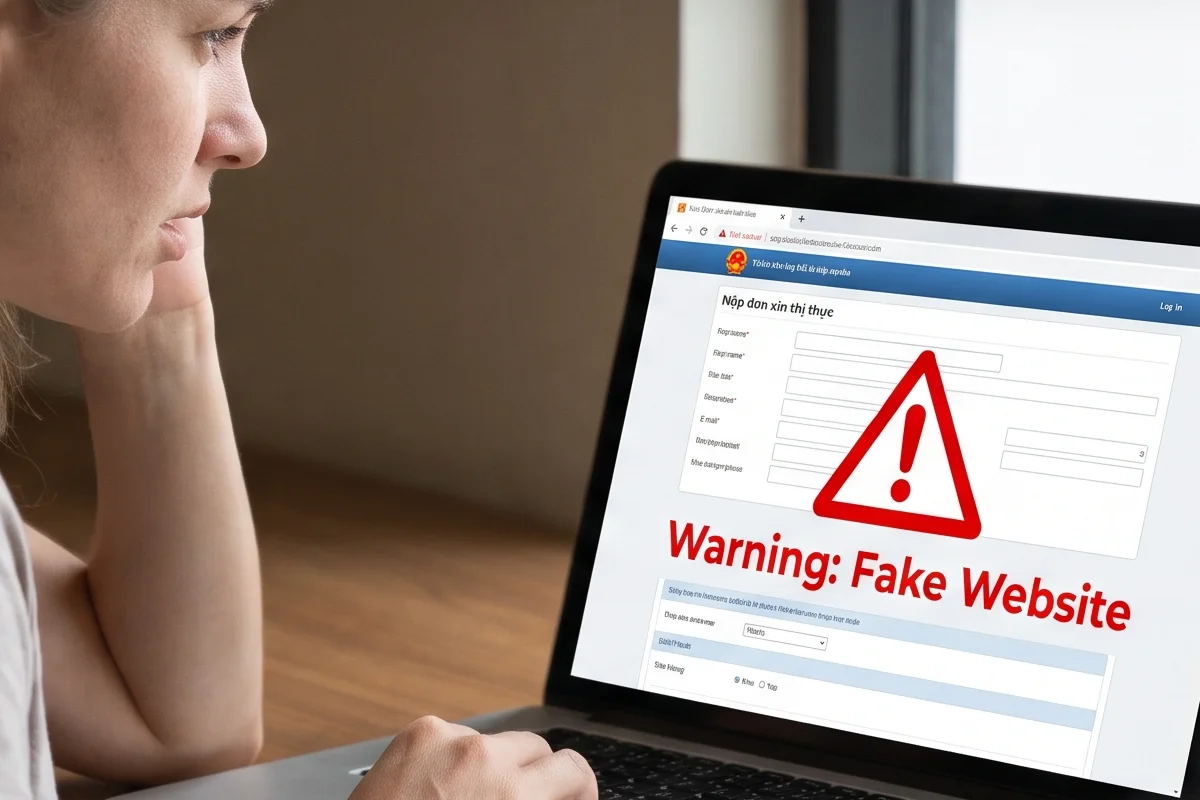
The second is the copycat markup. These sites imitate the official portal’s colours, wording and forms, and they do submit your application — but at two or three times the real price. A visa that costs US$25 on the government portal is sold for US$70, US$90 or more, with the difference hidden inside invented line items such as inflated “government fees”, “processing fees” and “approval service” charges.
The third flavour is the urgency upsell: countdown timers, “only a few slots left today”, and expensive “emergency” or “express” tiers that promise approval in a few hours for a large surcharge — exploiting travellers who left their application late and are panicking. Underneath the theatre, it is the same standard application anyone can file directly.
These sites stay profitable because they buy the advertising slots at the top of search results, so the copycats appear above the real government portal. The first result is not the official result — it is simply the highest bidder.
Red Flags: Signs a Vietnam Visa Website Is Not Official
- The domain does not end in .gov.vn. This is the decisive test. The official portal is evisa.gov.vn (or thithucdientu.gov.vn). A .com, .org, .net or .io address is a business, full stop — even if the page says “Vietnam Immigration” in large letters.
- It is a sponsored ad. The government portal does not need to advertise. If the result is labelled “Sponsored”, treat it as a shop, not an office.
- The “government fee” is more than US$25 / US$50, or the total is broken into confusing layers of fees you cannot reconcile with the official price.
- Pressure tactics: countdown clocks, “only 2 slots left”, pop-ups warning that prices are about to rise.
- Guarantees: promises of “100% approval guaranteed” or approval within a few hours for a large fee. Only the Immigration Department decides, and nobody can guarantee its decision.
- Old-system charges: requests for a “stamping fee” on an e-Visa. Stamping fees belong to the old visa-on-arrival system; an e-Visa has no fee to pay on arrival.
- Look-alike spelling: extra words, hyphens or swapped letters wrapped around “Vietnam eVisa” in the address, designed to be misread at a glance.
- No verifiable identity: no real company name, address or registration behind the site — just a form and a payment button.
- Documents demanded over email or chat before you have even seen a proper application form — a pattern associated with data harvesting rather than visa processing.
How to Check Any Visa Website in 30 Seconds
- Read the domain letter by letter. Not the page design, not the logo — the address bar. You want evisa.gov.vn, exactly.
- Type the address yourself. Never arrive at a visa site through an ad or a link in an unsolicited email. Typing evisa.gov.vn directly removes the entire category of copycat risk.
- Compare the price before you pay. On the payment screen, a standard e-Visa should total US$25 (single entry) or US$50 (multiple entry). If the number is far higher, stop and restart on the official portal.
- Check the domain again at the payment step. Some funnels start on one address and hand you to another for payment; the domain deserves a second look at the exact moment money is involved.
Already Paid the Wrong Site? Do This Now
First, work out which flavour you are dealing with, because the recovery differs. If the site was a copycat agency, a genuine e-Visa may still arrive — your loss is the markup, not the visa. If it was a pure scam, nothing will arrive. Either way, act in this order:
- Verify anything you receive. A real e-Visa approval can be checked on the official portal’s lookup function using the registration code connected to the application. If the agency gave you a code, test it on evisa.gov.vn. If the document they sent cannot be verified there, treat yourself as not having a visa.
- Watch the clock. The official processing standard is 3 working days. If departure is approaching and you hold nothing verifiable, do not gamble on the unknown site.
- Apply again on the official portal if needed. A fresh application on evisa.gov.vn costs the standard fee, and it is the only version whose result you can fully trust. Money paid to a third-party site does not transfer to the government application.
- Contact your bank or card issuer promptly. Report the transaction, explain that the service was misrepresented or never delivered, and ask about disputing the charge. Keep screenshots of the site, the payment page and every email as evidence — pages like these change or disappear quickly.
- Protect your passport data. If you uploaded a passport scan to a site you no longer trust, be alert: treat unexpected “immigration” emails or calls with suspicion, and never pay a second “release fee” to the same people — a common follow-up sting.
How to Check Your Real Application Status
However you applied, the only status that matters is the one on the official portal. On evisa.gov.vn, open the e-Visa lookup/search function and enter your registration code, email address and date of birth. The portal will show whether your application is being processed or decided, and once approved you can download the official e-Visa document from there. An email, screenshot or PDF supplied by an agency is worth believing only when the same result appears in that official lookup. Save your registration code the moment you apply — without it, checking and recovering your result becomes much harder.
The Safe Routine, Every Time
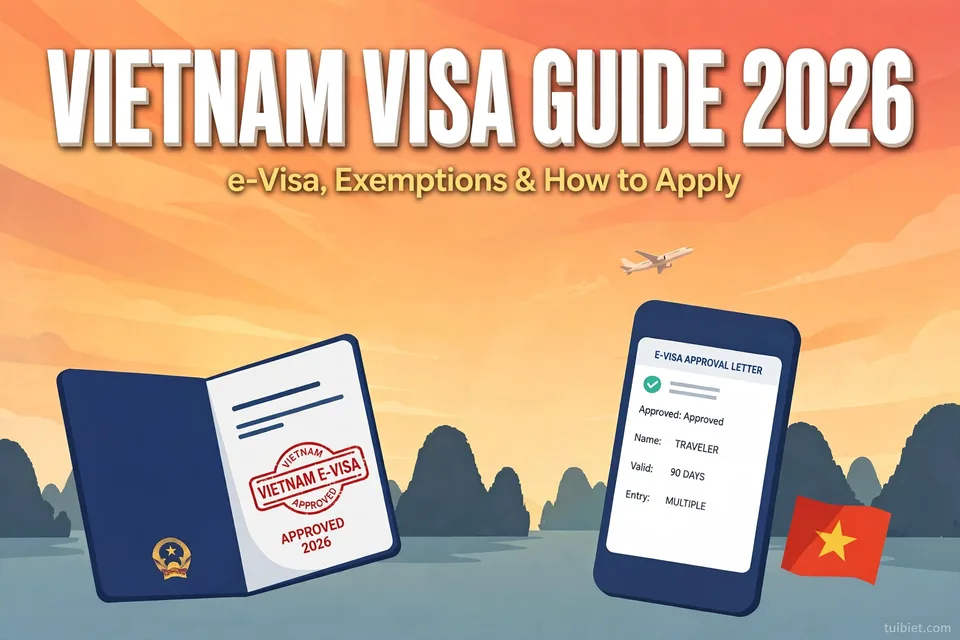
Fold the whole defence into five habits and Vietnam visa scams lose their power: type evisa.gov.vn yourself; ignore sponsored visa ads; pay only the published government fee; save your registration code; and collect your result from the official portal’s lookup, then print it. The process itself is short — our pillar guide to Vietnam visa requirements, exemptions and how to apply walks through the rules for every nationality, and you can watch the same official process applied step by step in our guide to the Vietnam visa for Indian citizens.
Frequently Asked Questions
Which website is the real Vietnam e-Visa site?
evisa.gov.vn, run by Vietnam’s Immigration Department — the same system is also reachable at thithucdientu.gov.vn. If the address in your browser is anything else, you are on a commercial website.
Is a site ending in .org or .com an official Vietnam visa site?
No. Official Vietnamese government services use the .gov.vn domain. A polished design, a government-sounding name and a flag logo do not change what a .com or .org address is: a private business.
I paid US$90 to an agency site. Was I scammed?
Possibly overcharged rather than scammed. Many agency sites do submit real applications and keep a large markup. Verify the result on the official portal’s lookup: if a genuine e-Visa appears, it is usable — you simply paid far more than the US$25 or US$50 it costs to apply directly.
Can a fake visa site steal more than money?
Yes. A passport scan contains your full name, date of birth, passport number and photograph — material for identity fraud and convincing phishing. That is why the data-protection steps above matter even when the money is recovered.
Do legitimate travel agents exist?
Yes. A legitimate agent presents itself honestly as a business, charges a transparent service fee, and never impersonates a government department. Even then, applying yourself on the official portal takes only a few minutes and costs nothing beyond the government fee.
Sources: Vietnam Immigration Department e-Visa portal (evisa.gov.vn) — the sole official channel for Vietnam e-Visa applications. Fees and rules can change; always confirm the latest information on the official portal before applying.