
 Tiếng Việt
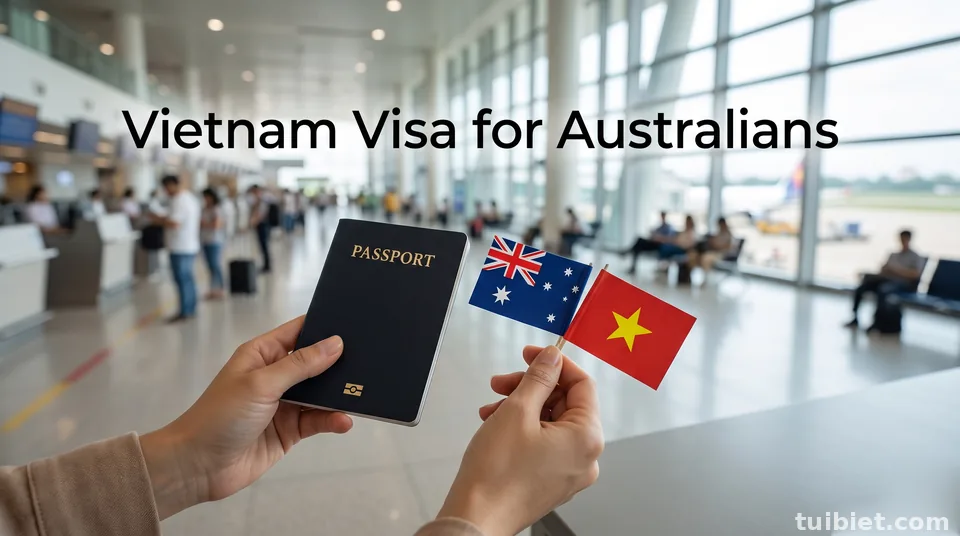
Sorting out your Vietnam visa for Australians is the one job you cannot leave until the airport. Unlike travellers from the UK or much of Europe, Australian passport holders do not get visa-free entry to mainland Vietnam, and airlines check your paperwork before you board. The good news is that almost everything happens online: no embassy visit, no paper forms in the post, just one official application you can complete from your couch. This guide covers who needs a visa, what the e-visa actually gives you, what it costs, how to apply step by step, and the two mistakes that catch Australian travellers out most often. For the bigger picture across all nationalities, see our complete Vietnam visa guide 2026: e-visa, exemptions and how to apply.
Do Australians Need a Visa for Vietnam?
Yes. Australia is not on Vietnam’s visa exemption list, so a Vietnam visa for Australians is required for holidays, business trips and family visits alike — even for a short stop where you leave the airport and clear immigration. There is no visa-free period for Australian passport holders visiting the mainland, and there is no walk-up visa counter waiting for unprepared arrivals. Your visa must be arranged before you travel, and your airline will usually ask to see it at check-in.
The rules are different for other passports, which is where much of the confusion starts. Some European passport holders receive up to 45 days visa-free, and travellers from the United States follow a similar e-visa route to Australians, as explained in our guide to the Vietnam visa for US citizens. Advice written for those nationalities does not apply to an Australian passport, no matter how similar the trip looks.
The one narrow exception: Phu Quoc
Travellers who fly or sail directly to Phu Quoc Island, stay only on the island and leave Vietnam from Phu Quoc within 30 days may qualify for a visa exemption for that island-only trip. The moment your itinerary includes the mainland — even one night in Ho Chi Minh City on the way home — you need a visa like everyone else. Most Australian itineraries tour the mainland, so treat Phu Quoc as a special case, not the default.
One more special case: people of Vietnamese origin, and the spouses and children of Vietnamese citizens, may be eligible for a five-year visa exemption certificate through a Vietnamese embassy or consulate. If that sounds like you, it is worth asking the Embassy of Vietnam in Canberra before you apply for an e-visa.
Vietnam Visa for Australians: The E-Visa Explained
For nearly every Australian traveller, the e-visa is the answer. Since August 2023, Vietnam has issued e-visas to citizens of all countries and territories under Resolution 127/NQ-CP, and the system is run by the Vietnam Immigration Department under the Ministry of Public Security. Here is what the e-visa gives you:
- Validity: up to 90 days, far longer than most holidays need.
- Entries: choose single entry or multiple entry when you apply.
- Purposes: tourism, business and visiting family are all covered.
- Where it works: the e-visa is accepted at designated international entry points, including the major airports in Ho Chi Minh City, Hanoi and Da Nang. You must enter through the checkpoint you nominate in your application, so lock in your first arrival point before you apply.
- Where you get it: only through the official portals evisa.gov.vn and thithucdientu.gov.vn. Any other website is a private agency or worse, a scam (more on that below).
Choose multiple entry if your trip leaves Vietnam and comes back — for example, a side trip to Cambodia or Thailand in the middle of a longer journey. A single-entry e-visa ends the moment you exit Vietnam, even if days remain on it.
What You Need Before You Apply
The application itself takes about 15 minutes if your documents are ready. Prepare the following first:
- Passport: valid for at least six months, with at least two blank pages. Check the expiry date now, not the week you fly — Australian passport renewals take time.
- A digital passport-style photo of yourself, recent and meeting the portal’s size and format requirements.
- A clear scan or photo of your passport biodata page — the page with your photo and details.
- Your entry checkpoint and arrival date, plus the address of your first stay in Vietnam.
- An international payment card for the fee.
One detail deserves bold type in your mind: every field must match your passport exactly, including middle names, the order of your names, your date of birth and your passport number. Australia’s Smartraveller service warns that errors on an e-visa can lead to correction costs, denied boarding or refused entry. Check the finished application character by character before you pay.
How to Apply, Step by Step
- Go to the official portal. Type evisa.gov.vn into your browser yourself (the same system also runs at thithucdientu.gov.vn). Do not click a sponsored search result.
- Start an application and choose your visa type. Select single or multiple entry, your entry checkpoint and your planned dates, up to a maximum of 90 days.
- Fill in the form and upload your documents. Enter your details exactly as they appear in your passport and upload your photo and passport page.
- Pay the fee and save your registration code. You need this code to check your result, so screenshot it or write it down somewhere safe.
- Wait for processing, then download the PDF. Check the portal with your registration code; once approved, download your e-visa.
- Print a copy and save an offline copy on your phone. Smartraveller notes you may be asked to show a printed e-visa at airline check-in or on arrival, and airport Wi-Fi is not the place to discover you cannot access your email.
How Much Does a Vietnam Visa for Australians Cost?
The official government fee is refreshingly simple, and paying it is also your best scam test:
| E-visa type | Official fee | Best for |
|---|---|---|
| Single entry (up to 90 days) | US$25 | One trip into Vietnam, leaving from Vietnam |
| Multiple entry (up to 90 days) | US$50 | Trips that leave Vietnam and return |
The fee is paid through the portal’s online payment gateway and is non-refundable, even if your application is refused — another reason to check every field before you submit. Note: these are the official fees at the time of writing, and actual fees may change at the time you apply, so confirm the amount shown on the official portal before you pay. If a website quotes you US$80, US$120 or more for a standard e-visa, you are not on the government site; that extra money is an agency service charge at best.
How long does processing take?
Standard processing is around three working days. That is the clean-case timeline: if immigration needs you to amend or add information, the clock stretches, and straightforward applications can take around four working days to arrive. Apply at least a week before departure — two weeks is calmer — and remember that Vietnamese public holidays do not count as working days. Never book a non-refundable flight for tomorrow on the assumption your visa will land overnight.
Avoiding Fake Visa Websites
The e-visa’s popularity has created an industry of lookalike websites, some merely expensive and some outright fraudulent. Official-looking names, copied logos and top-of-Google ads are all part of the performance. Before you enter a single detail, run two checks: the address must be one of the two official domains ending in .gov.vn, and the fee must be US$25 or US$50. We have documented how these operations work in our guide to Vietnam visa scams and fake websites that charge triple the fee — it is worth five minutes before you hand over your passport scan and card number to anyone.
E-Visa or Embassy Visa: Which Route Suits You?
The e-visa covers the overwhelming majority of Australian trips: holidays, short business travel and family visits of up to 90 days. The embassy route still exists for everything outside that box — longer stays, work or study arrangements and complex cases. Vietnam’s Embassy in Canberra and its consulates in Australia can advise on those categories and on the five-year exemption certificate mentioned earlier. Processing through a mission takes longer than the e-visa, and you will be without your passport while it is processed, so start early if this is your route.
What about “visa on arrival”? Despite the name still floating around agency websites, it is not an option to simply land and sort things out at the airport. Any arrival-based arrangement must be pre-approved before departure, and for an ordinary holiday the official e-visa is simpler, cheaper and fully in your hands.
After You Arrive: Entry Rules Worth Knowing
- Enter through your nominated checkpoint. Your e-visa is tied to the entry point in your application; arriving somewhere else can mean being turned around.
- Keep your printed e-visa with your passport. You may need to show it again, and domestic flights inside Vietnam require the passport you entered on.
- Respect the dates. The e-visa generally cannot be extended or converted once you are inside Vietnam, so choose your validity window generously when you apply.
- Check Smartraveller before you go. Entry rules and local conditions change; the Australian Government’s Vietnam travel advice page is the quickest final check in the week before departure.
Vietnam Visa for Australians: Frequently Asked Questions
Can Australians get a visa on arrival in Vietnam?
No — not in the walk-up sense. Australian passport holders must hold an appropriate visa before travelling, and airlines can refuse boarding without one. The e-visa is the standard route for holidays and short trips.
How long can Australians stay in Vietnam on an e-visa?
Up to 90 days, on either a single-entry or multiple-entry e-visa. Apply for the full window you might need, because the visa generally cannot be extended after you arrive.
How much does the e-visa cost?
US$25 for single entry and US$50 for multiple entry on the official portal, non-refundable. Actual fees may change at the time you apply, so treat the amount on evisa.gov.vn at checkout as the final word.
Can I visit Phu Quoc without a visa?
Possibly, if your whole trip stays on the island: travel directly to Phu Quoc, remain there, and depart from Phu Quoc within 30 days. Any mainland stop removes the exemption, and you will need a Vietnam visa for Australians in the normal way.
What if I make a mistake on my application?
Small errors matter. Details that do not match your passport can cause problems at check-in or the border, and fixing them can mean a new application and a new fee. Recheck names, passport number, dates and your entry checkpoint before paying — and again on the approved e-visa as soon as it arrives.
Rules, fees and processing times were checked against official sources in November 2026, but entry requirements can change. Always confirm the details on evisa.gov.vn and Smartraveller shortly before you travel.