
 Tiếng Việt
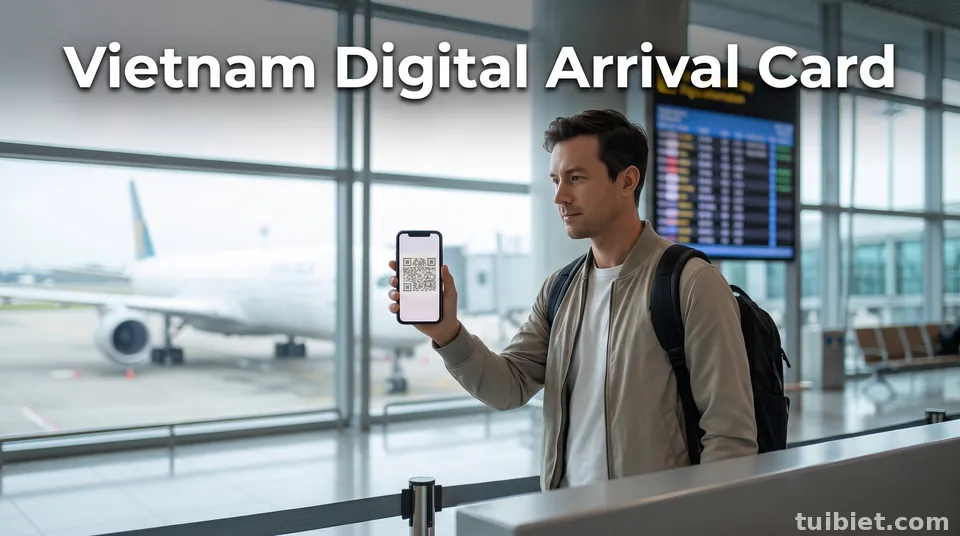
Vietnam has quietly added a new step to the arrival process in 2026, and many travellers only hear about it when they reach the immigration hall. The Vietnam digital arrival card — officially the Pre-Arrival Information system, or PAI — is a free online declaration run by the Vietnam Immigration Department. If you are flying into one of Vietnam’s five largest international airports on a foreign passport, this form now sits alongside your visa paperwork. This guide explains what the Vietnam digital arrival card is, who has to complete it, when to submit it and how to do it on the only official portal.
What is the Vietnam digital arrival card (PAI)?
The Vietnam digital arrival card is the electronic version of the paper arrival form passengers used to fill in on the plane. Instead of writing your details on a slip of paper and handing it to the border officer, you submit the same information online before you travel: your passport details, your visa status, your flight and your address in Vietnam. The system then generates a personal QR code, which the border police scan when you reach the passport control desk.
The system is operated by the Immigration Department under Vietnam’s Ministry of Public Security — the same authority that runs the national e-Visa system. It was piloted at Tan Son Nhat International Airport in Ho Chi Minh City from 15 April 2026 and has since been extended to five international airports: Tan Son Nhat (Ho Chi Minh City), Noi Bai (Hanoi), Da Nang, Cam Ranh (Nha Trang) and Phu Quoc. The only official website is prearrival.immigration.gov.vn.
Two things are worth stating plainly. First, the declaration is completely free — there is no payment step at any point. Second, it is not a visa and gives you no permission to enter Vietnam. It is an information declaration only, and the Immigration Department itself stresses that the PAI system does not receive or approve visa applications.
Who has to complete it — and who does not
The declaration is aimed at foreign arrivals at the five airports listed above. In practice, you should complete it if you are:
- A foreign national entering Vietnam on an e-Visa;
- A foreign national entering visa-free under one of the exemption schemes (check whether your passport qualifies in our guide to the Vietnam visa exemption list);
- An overseas Vietnamese entering on a foreign passport with a visa;
- Arriving on any other visa or entry permit issued for Vietnam.
You do not need the declaration if you are a Vietnamese citizen entering on a Vietnamese passport, or a transit passenger who stays airside and never clears immigration. As of late 2026 the system covers air arrivals at the five airports only; travellers entering at land borders are not part of the scheme yet, although the Immigration Department says wider expansion is under study.
One honest complication: official descriptions of the pilot have not all used the same wording. The Immigration Department launched PAI as a trial system, and a Ministry of Foreign Affairs notice in September 2026 described the pilot as voluntary. At the same time, the notices issued for Tan Son Nhat and Phu Quoc airports instruct foreign arrivals to complete the declaration before passport control. Our advice is simple: treat the Vietnam digital arrival card as required. It takes a few minutes, costs nothing, and passengers who skip it simply end up completing the same form on airport QR codes in the arrivals hall — with a queue attached.
When to submit: the 3-day window
You can only file the declaration shortly before travel. The portal accepts submissions within 3 days (72 hours) before your arrival — earlier than that, the system will not take your arrival date. Most travellers complete it the day before departure, alongside online check-in. Submit one declaration per person, including for children travelling on their own passports.
If your flight is rebooked to a different day, submit a fresh declaration for the new arrival date so the QR code matches the journey you actually take.
How to complete the Vietnam digital arrival card, step by step
Have your passport, flight number and the name or address of your first night’s accommodation in Vietnam ready, then follow the official procedure published by the Immigration Department:
- Open the official portal. Type prearrival.immigration.gov.vn into your browser yourself — do not follow links from ads or visa agent sites (see the warning below).
- Choose your language. The portal works in Vietnamese, English, Chinese, French and several other languages.
- Select “Create and Submit Declaration” and enter the CAPTCHA verification code shown on screen.
- Declare your passenger information — full name, date of birth, nationality and passport number, copied exactly as they appear in your passport.
- Declare your visa information — whether you are entering on an e-Visa, under a visa exemption, or with another entry permit.
- Declare your travel information — flight number, arrival date and airport, and your address or hotel in Vietnam.
- Submit and save your QR code. The system generates a personal QR code on completion. Screenshot it and keep a printed copy with your passport; you will show it at the immigration checkpoint on arrival.
At the border, the officer scans your QR code and your pre-submitted details appear on their screen, which is the entire point of the system: less typing at the desk, shorter queues for everyone.
Arrival card or e-Visa? You may need both
The most common misunderstanding is that the arrival card replaces the visa. It does not. They are two separate systems run for two separate purposes:
| Vietnam digital arrival card (PAI) | Vietnam e-Visa | |
|---|---|---|
| Purpose | Pre-arrival information declaration | Legal permission to enter Vietnam |
| Cost | Free | Government fee applies |
| When | Within 3 days before arrival | Well before you travel |
| Result | QR code shown at immigration | e-Visa document checked at the border |
| Official site | prearrival.immigration.gov.vn | evisa.gov.vn |
If your nationality is not visa-exempt, you still need an approved e-Visa before you fly — our complete Vietnam visa guide walks through the e-Visa, the exemptions and the entry requirements in one place. Being visa-exempt does not excuse you from the arrival card either: exempt travellers are exactly the passengers the declaration is designed to register, because they have no visa application on file.
Warning: fake arrival card websites are already operating
Wherever a new travel form appears, copycat sites follow. Vietnam’s Ministry of Foreign Affairs has warned that fraudulent websites impersonating the PAI platform have been detected, designed to harvest payments and credit card details from travellers who believe they are paying an official fee. Remember: the real Vietnam digital arrival card never asks for money. If any page requests card payment for a “Vietnam arrival card”, close it immediately. This is the same pattern we documented with fake e-Visa portals in our investigation of Vietnam visa scams and fake websites — the defence is always the same: type the official .gov.vn address yourself and pay nothing.
Frequently asked questions
Is the Vietnam digital arrival card mandatory?
Officially it began as a pilot, and descriptions vary between “voluntary pilot” and airport-level instructions telling foreign arrivals to complete it. In practical terms, treat it as mandatory at Tan Son Nhat, Noi Bai, Da Nang, Cam Ranh and Phu Quoc: it is free, takes minutes, and arriving without it means filling in the same form on arrival under time pressure.
How much does the Vietnam digital arrival card cost?
Nothing. The declaration on prearrival.immigration.gov.vn is free of charge, and any website charging a fee for it is not official.
Can I complete the declaration after I land?
Yes — QR codes posted around the arrivals halls at the covered airports link to the same portal, so you can file on your phone after landing. Expect it to slow you down at busy times, which is why the authorities recommend submitting before departure.
Does the arrival card replace my e-Visa or visa exemption?
No. The card is an information declaration only. Your right to enter Vietnam still comes from your e-Visa, a visa exemption or another valid entry permit, and border officers will check that document as before.
I am only transiting through Vietnam. Do I need it?
Not if you remain in the transit area and do not formally enter Vietnam. If your itinerary requires you to clear immigration — for example to change terminals on separate tickets — complete the declaration like any other arriving passenger.
Sources: Vietnam Immigration Department (Ministry of Public Security), Pre-Arrival Information portal, prearrival.immigration.gov.vn; Ministry of Foreign Affairs of Vietnam, notice “On the Implementation of the Pre-arrival Information Application for Foreigners Entering Viet Nam”, 30 September 2026. Rules for new border systems change quickly — re-check the official portal shortly before you fly.